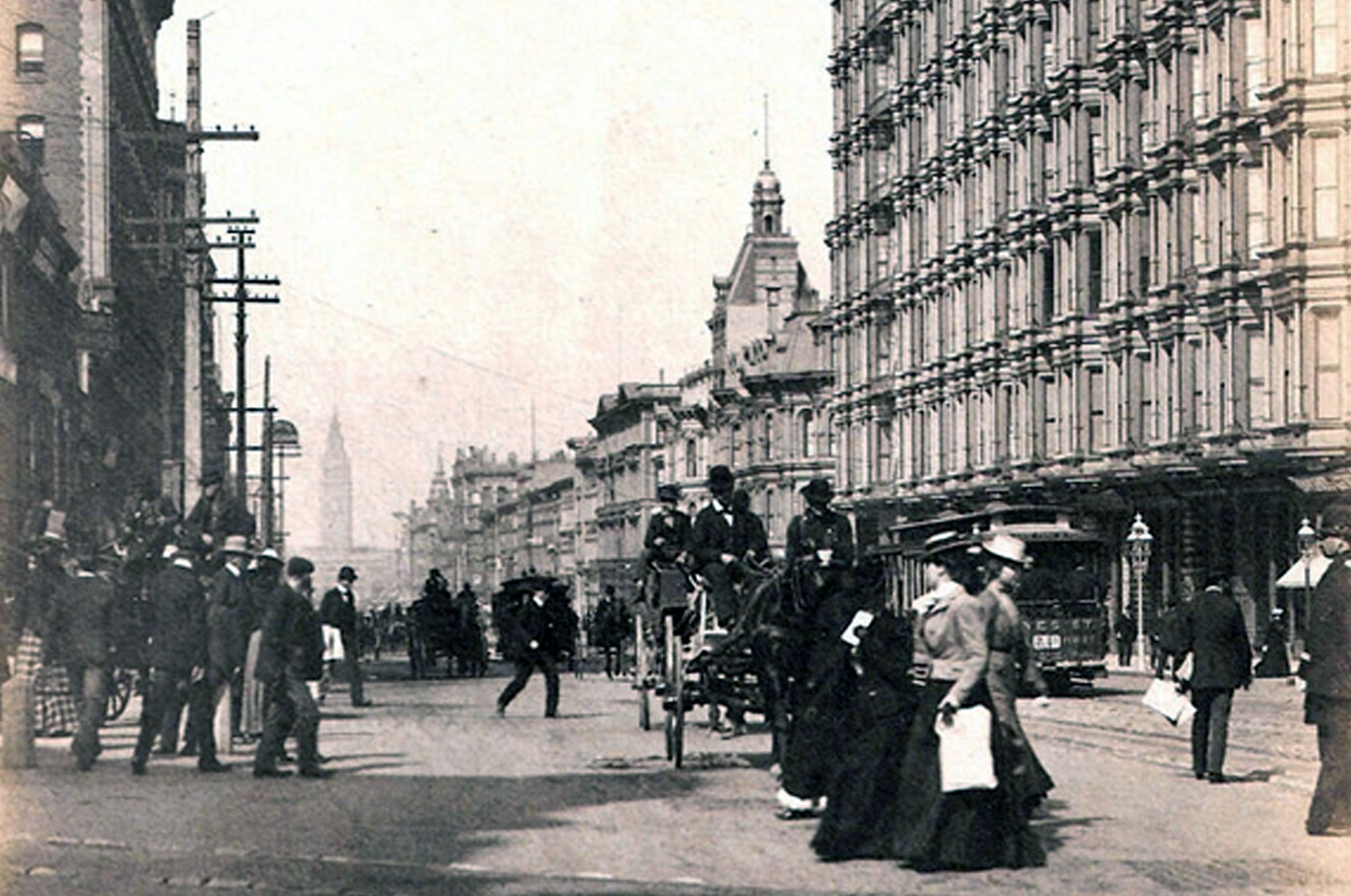
"Confessions of a Bunco Man" and one 20th century sucker, swindle, and scheme
"Where do I come in?" I asked.
"You're the broker's son," said "Kid" Welch. We'd met by accident at the Cafe Royal Poker Rooms at Market and Fourth Streets in San Francisco. I was so broke after losing a job his coat was held as a security deposit at the poker room. Welch could tell I needed cash, and rumor was a lumberman from Oregon was in town with a thick wad of cash.
The plan seemed simple enough: I'd play the role of "Toby", a well-dressed, well-to-do son of a broker. All I had to do was walk into the hotel bar with Welch and drink a little wine. Meanwhile, the lumberman from Oregon was already at the hotel bar with another man who has been hyping up my game.
"He's so nervous for fear you won't come that he can't sit still. He's our meat. As soon as we finish our drink we'll go across the street to the room where the layout is. When our friend comes in you start talking about pikers and offer to bet your roll on one turn of the dice. He'll accept. If he wants to bet a thousand, cover it and offer to bet someone else five hundred more. He'll probably take that, too. It don't make any difference who is rolling the dice," said Welch. "When the big bet is made "craps" will be turned on the next roll. Pick up the money then and follow me, no what what happens."
The two men sauntered into the hotel bar. Out of the corner of my eye, I spotted a heavy-set middle-aged man with a beard and a black broadcloth suit. He was sitting with a nicely-dressed young man. I recalled seeing the young man around the Tenderloin.
Welch and I drank our wine, chatting quietly. When I was sure our meat was looking I peeled off a $100 bill to pay the tab, knowing he'd spot the fat wad of cash that Welch handed me on the way over. Then we left.
We walked across the street and headed upstairs in a room situated above a real estate office. The windows overlooked Market Street, but the blinds were drawn. There was nothing in the room but a table, a few chairs, and a cheap "crap" layout painted on canvas. Behind the table was the "dealer", and around the table sat a half dozen men pretending to be shooting craps.
"He's coming," said Welch.
I took my place at the end of the table. The dice were rolled and on each turn the bunch around the table won and lost bills of all denominations. As I sat there, the door opened and the man I'd seen around town and the lumberman walked in. I looked at the man. No one else turned to look.
"Bet you fifty I'm right," said one of the men sitting at the table."
"A hundred more he comes," said a man at the other end.
"You're both on," I answered, setting my cash roll on the table. A few others around the room made cursory bets to keep up appearances. Then we threw the dice.
After a few cursory rounds, I rolled a fateful seven and won. Gathering up the money across the tabled I yawned. "This game's too slow for me."
The lumberman had wedged his way forward around the table and proclaimed, "I'll make any gentleman here a bet of $1,000 on a single roll of the dice."
He had my attention. "Make it $2,000 and I'll take you," I said, then, for effect added, "What's $1,000?"
The lumberman hesitated, but the "sharper" who brought him in urged him on. He drew out his cash and counted it on the table. He had $1,595. He pushed $1,500 on the table and pocketed the $95.
Sitting back down, I put up a match while the other bets were made. "I'm betting the shooter loses," I said. "Your money goes that he wins."
The dealer sat quietly until he asked, "Are you all ready, gentlemen?"
"Let 'em roll," I said. The lumberman from Oregon's eyes bulged as large as billiard balls as he sat quietly.
A fellow we called "Shorty", supposedly killed in a railroad accident a year earlier, rolled the dice in grand fashion, first holding them up to his ear and then sending them down the length of the table.
The beauty of those dice was no matter how you rolled them, they turned "craps". Over and over they turned on the tabled, while everyone seemed to hold their breath. Then they stopped, both showing one.
"Craps," proclaimed the dealer, shoving a pile of cash in my direction. "The gentleman has shot craps and loses!" The lumberman's face grew almost purple.
Just then, a ruckus outside began beating on the door.
"The police!" shouted the dealer, snatching away the table layout and turning off the lights. "The cops are coming!"
Welch grabbed my wrist and dragged me through a door hidden by portiers and clouded in darkness. We scrambled to get out but once outside, instead of going down the stairs toward the street, we hurried along a corridor and down another stairway near Kearney Street. Once on Market Street, we hurried around the Chronicle corner and disappeared into the first saloon we saw. I turned over the roll of money, including what we'd just won. He handed me a $100 bill. "Say, kid, you've got real talent. You did that like an old-timer. You stick with me and I'll make you a fortune. What do you say, do you want to be one of us?"
My heart was still beating out of my chest. "Sure," I said, "But I had been frightened by the cry of police. How were you so calm?"
Welch roared with laughter. "That was only one of my boys hammering on the door to make the getaway easier."
Since then and over the last twelve years, I've been in nearly every city in America. The supply of suckers never fails. All you have to do is pick out a lively looking customer, spend the price of a dinner on him, and find out whether he has money. If he has, and you have the right sort of game ready, his money is as good as yours.
Trick dice, changed cards, and a century of Buncos
A $1,000 bet in 1907 (a year after the Great San Francisco Earthquake) would be the same as about $35,000 in 2026. While the above story was real and involved Craps, countless other stories of the era involved Poker, Texas Hold 'Em, Blackjack, Roulette, and, of course, Bunco and other dice games.
Bunco Men got their name from the easy swindles, trick dice, stacked decks, and fake cards or chips that became popular in the early 20th century. None more so than with Bunco, a quick, easy game that meant fast payouts, more marks, and easy escapes into a crowd.
The response to this crime surge was police "Bunco Squads", tasked in many cities with rooting out these high-dollar crimes in saloons, bars, taverns, and discrete tables.
The highs and lows of being a Bunco Man, as "Toby" explained in 1907, meant, "A bunco man's life is a hundred-dollar dinner tonight and a free lunch handout tomorrow."
Luckily, you can play the original Bunco parlor game online, with no risk (and no money!) anytime.